If you’ve lived in Georgia long enough, you know our winters are short but sharp—and there is nothing worse than a furnace failing during a January freeze. Whether you are in the North Georgia mountains or the coastal plains, that sudden drop in temperature makes a functioning heating system a necessity, not a luxury.
Navigating the wide range of quotes from Atlanta to Savannah can be overwhelming, especially when prices for the same unit vary by thousands of dollars. You might find one contractor quoting you $4,500 while a big-box retailer suggests a “premium package” for $11,000.
This guide acts as your consumer advocate, breaking down the real math behind furnace replacement costs. We want to help you spot high-pressure sales tactics and choose the right system for your home without overpaying for corporate overhead.
What is the Average Cost of a Furnace Replacement in Georgia?
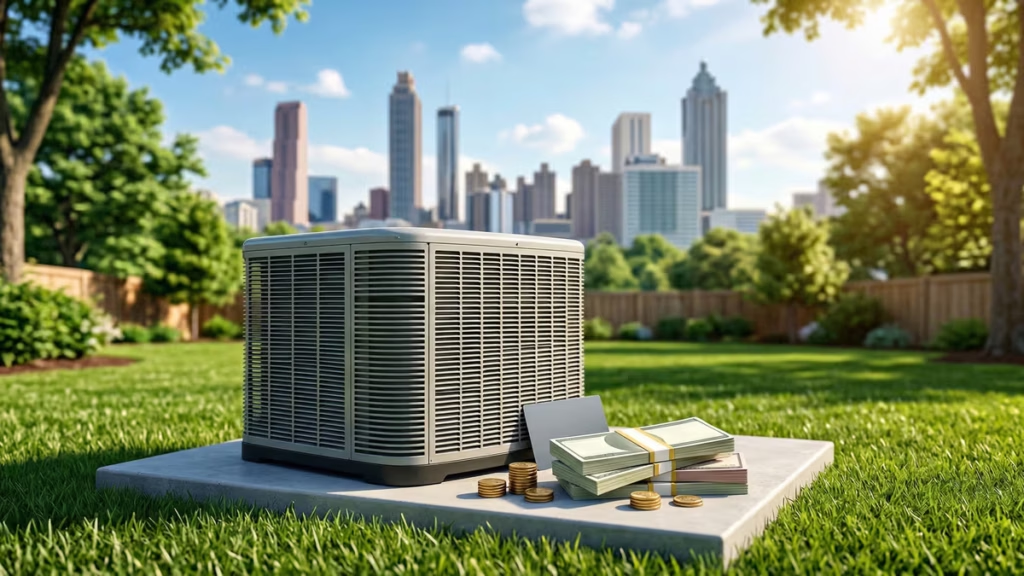
When you start shopping for a new heating system, the numbers can feel like a moving target. In Georgia, the typical range for a standard furnace installation falls between $3,500 and $8,500. This includes the unit, labor, and basic modifications to your existing setup.
However, high-efficiency systems in affluent suburbs like Alpharetta can easily reach $12,000 or more. These “premium” installs often involve complex venting requirements and high-stage blowers that offer superior comfort but come with a steeper upfront price tag.
Local Price Benchmarks and Real-World Quotes
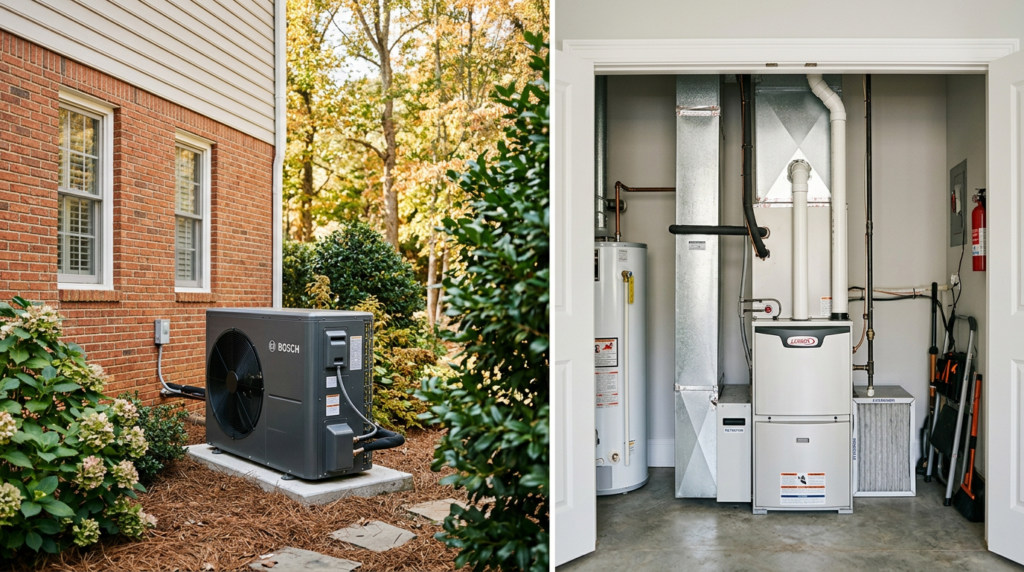
To understand where your money goes, you have to look at the equipment itself. An 80% AFUE (Annual Fuel Utilization Efficiency) furnace is the baseline for our region; these units are simpler to install because they can often use your existing metal chimney flue.
A 96% AFUE unit, on the other hand, requires specialized PVC venting to handle acidic condensate. While the equipment cost difference might only be $800, the labor to run new vent pipes through your roof or side wall can add another $1,000 to the total.
Many homeowners are tempted by “Costco” or “Home Depot” programs that offer 10% shop cards as an incentive. While these seem like a deal, these big-box retailers often take a significant “finder’s fee” from the contractor, which is usually baked into a higher total project cost.
The Impact of Georgia’s Climate on System Choice
Georgia sits in a “mixed-humid” climate zone, meaning our winters are relatively mild compared to the Midwest. Because our heating season is shorter, the “payback period” for an ultra-high-efficiency furnace is much longer than it would be in Chicago or Boston.
Data regarding Georgia residential energy efficiency potential suggests that homeowners can save significantly on monthly bills by focusing on a “whole-home” approach rather than just the furnace. In many cases, a mid-range furnace combined with better insulation provides a better return on investment.
Sizing is another critical local factor. An oversized furnace in a Marietta home will “short-cycle,” turning on and off rapidly, which wears out the components and leads to a premature death for the system. A proper load calculation is more important than the brand name on the cabinet.
Shoulder Season Pricing vs Emergency Surcharges
Timing your purchase is one of the most effective ways to save money. In Georgia, the “Peak Seasons” are November through January (heating) and June through August (cooling), when labor rates spike due to high demand.
If your 15-year-old unit is struggling, try to schedule your replacement in March or October. These “shoulder seasons” are when local contractors are looking to keep their crews busy, making them much more likely to offer “slow season” discounts or flexible financing.
You will also find that “two-man outfits” in Gwinnett or Lawrenceville often beat the pricing of large corporate entities. These smaller shops don’t have the massive marketing budgets or television commercial costs that national chains pass down to the consumer.
Which Factors Most Heavily Influence Your Final Bill?
The final number on your contract isn’t just about the furnace; it’s about the infrastructure supporting it. In Georgia, we have a unique mix of all-electric homes and those with natural gas access, which dictates your technology options.
Reviewing how much should HVAC cost in Atlanta can help you determine if a local quote falls within the expected market average for 2024.
Gas vs Electric vs Dual-Fuel Hybrid Systems
Natural gas is a popular choice in Georgia due to its reliability during power outages. The upfront cost for a standard gas furnace installation is typically lower than a high-end heat pump, but it does require proper venting and gas line maintenance.
For many Georgia homeowners, a Hybrid or “Dual-Fuel” system is the gold standard. This involves pairing a gas furnace with an electric heat pump. The heat pump handles the 40-degree days efficiently, while the gas furnace kicks in for those rare 20-degree nights.
Before switching fuel sources, consider the “hidden” costs. Converting an all-electric home to gas requires running new lines and installing a flue, which can add $2,000 to $4,000 to the project. Always weigh these costs against your projected monthly savings.
AFUE Ratings and Long-Term Savings
AFUE stands for Annual Fuel Utilization Efficiency, and it tells you what percentage of the fuel you pay for actually turns into heat. An 80% AFUE furnace wastes 20 cents of every dollar, while a 96% unit only wastes 4 cents.
The federal government provides specific information for purchasing energy-efficient residential furnaces to help consumers understand these ratings. In Georgia, the “Law of Diminishing Returns” often applies; the extra $2,500 spent on a 98% efficiency unit may take 15 years to pay back in energy savings.
For most Georgia homes, a high-quality 80% unit or a standard 90% unit is the “sweet spot.” Unless you plan on staying in your home for 20+ years, the most expensive efficiency rating is rarely the most cost-effective choice for our specific climate.
Brand Reliability and Technician Serviceability
From a technician’s perspective, brand name is often secondary to part availability. Brands like Bryant, Carrier, or Goodman are popular in Georgia because almost every local supply house stocks their parts, meaning you won’t be waiting a week for a repair in the dead of winter.
It is a common industry saying that the quality of the furnace replacement matters more than the logo on the box. A poorly installed “premium” brand will fail faster than a perfectly installed “budget” brand every single time.
When reviewing quotes, look at the warranty. Most manufacturers offer a 10-year parts warranty, but the local contractor’s labor warranty is what protects you from out-of-pocket costs in the first few years. A 2-year labor warranty is standard, but some top-tier local shops offer 5 or 10 years.
Can You Lower the Cost Without Sacrificing Comfort?
One of the biggest mistakes Georgia homeowners make is buying a massive furnace to compensate for a “leaky” house. If your attic is poorly insulated, your new furnace will have to work twice as hard to keep you warm.
Before committing to a high-tonnage system, consider how a heat pump installation or a hybrid setup might allow for a smaller furnace unit when paired with professional home sealing.
Attic Air Sealing and Insulation Strategies
Spending $1,500 on air sealing and blown-in insulation in a vented attic can often allow you to downsize your furnace. By keeping the heat inside the living space, you reduce the “load” on the equipment, which saves you money on the purchase price and the monthly bill.
Research shows that the “thermal envelope” of the home—the walls, windows, and attic—matters as much as the HVAC equipment itself. If you live in an older home in a neighborhood like Buckhead or Midtown, your heat loss is likely through the ceiling, not a lack of furnace power.
Reducing the load of the house prevents the need for an expensive 5-ton unit when a 4-ton unit would suffice. This “right-sizing” is the most effective way to lower your project cost without sacrificing a single degree of comfort.
Georgia Rebates and Federal Tax Credits
The Inflation Reduction Act has changed the math for furnace replacements. Under the 25C tax credit, homeowners can shave up to $600 off a high-efficiency gas furnace or up to $2,000 off a qualifying heat pump system.
You should also check Georgia’s home energy rebates for state-specific programs that may be rolling out. Local utility providers like Georgia Power also offer rebates for moving to high-efficiency equipment or improving your home’s insulation.
For low-income homeowners in rural parts of the state, the USDA offers single family housing repair loans and grants that can be used to replace unsafe or non-functioning heating systems. These programs are vital for maintaining safety in Georgia’s older housing stock.
Alternative Heating for Secondary Spaces
If you have a “cold room” above a garage or a basement workshop, don’t assume you need to upgrade your entire central furnace to a larger size. Extending ductwork is expensive and often results in poor airflow to those distant rooms.
In places like Sandy Springs, many homeowners are opting for ductless mini-splits for additions or “bonus rooms.” This allows you to keep your main furnace at a standard, affordable size while providing localized, efficient heating where you actually need it.
Localized space heating is often more cost-effective for non-living areas. Rather than spending $5,000 to “beef up” your central system, a $2,000 mini-split can provide better comfort for that specific zone without straining your main unit.
Is it Time to Repair or Replace Your 20-Year-Old Unit?
If your furnace is over 15 years old, you are likely entering the “danger zone.” While a well-maintained unit can last 20 years, the efficiency and reliability drop off a cliff once the heat exchanger begins to age.
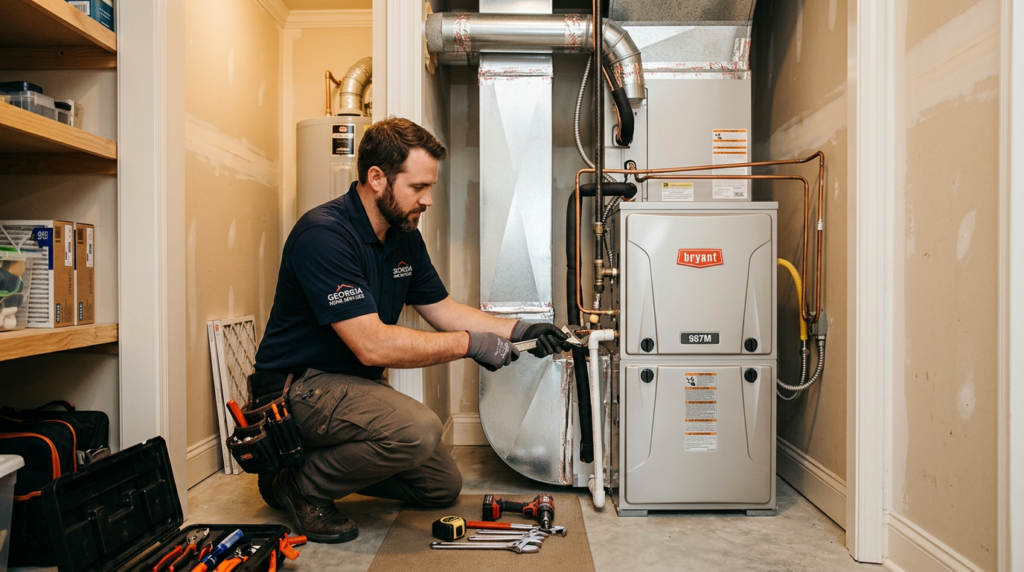
Deciding whether to sink money into an old unit or buy a new one is a common dilemma. If you are facing a major repair, scheduling a furnace replacement in Atlanta might be more economical than patching up a system that will likely fail again next season.
The $500 Repair vs $6,000 Replacement Matrix
A good rule of thumb is the “Decision Matrix”: Multiply the cost of the repair by the age of the furnace. If the result is higher than the cost of a new unit, it’s time to replace. For example, a $700 repair on a 15-year-old unit equals $10,500—well over the cost of a new system.
Safety is the other major factor. Older heat exchangers can develop hairline cracks that leak carbon monoxide into your home. If a technician shows you a crack in your heat exchanger, do not ignore it; this is a life-safety issue that requires immediate attention.
State officials often release a Georgia PSC winter heating advisory to remind residents to check their systems before the cold hits. If your unit is already showing signs of struggle during these checks, it’s better to replace it on your terms rather than in an emergency.
Performance Indicators of a Failing Furnace
Warning signs specific to Georgia homes include excessive dust (indicating leaky ducts or a failing blower), uneven heating in multi-story Roswell homes, and skyrocketing gas bills that don’t match the weather.
Short cycling—where the furnace turns on for three minutes and then shuts off—is a “silent killer.” It’s often caused by an overheating heat exchanger or a failing sensor. If your lights flicker when the furnace kicks on, your motor is likely drawing too much “startup” amperage.
Reliability for parts on units built before 2005 is also becoming an issue. Many manufacturers have discontinued components for these older models, meaning a simple $50 part might now require a $500 “universal” workaround that may not be as reliable.
Benchmarking Your Quote Against the Atlanta Market
To avoid “corporate bloat,” always get at least three quotes. Use a local pricing guide to see if your quote is “market rate.” If a salesman tells you the price is only valid if you sign “today,” walk away. That is a high-pressure tactic designed to prevent you from doing your homework.
When interviewing contractors, ask if they perform a “Manual J” load calculation. This is a scientific way of determining exactly how much heat your home needs based on its square footage, window types, and insulation levels. If they just “look at the old unit” to size the new one, they aren’t doing their job.
Be wary of “free” add-ons that aren’t actually free. Some companies will throw in a “free” UV light or media filter but then double the labor price of the furnace. Ask for itemized pricing so you can see exactly what you are paying for each component.
How Do You Choose the Right Georgia HVAC Contractor?
The contractor you choose is more important than the brand of furnace you buy. In Georgia, the HVAC market is flooded with national chains that spend millions on radio ads. While these companies are often reliable, you are paying for that advertising in your final bill.
Local independent shops usually offer a more personalized experience. They rely on word-of-mouth and local reputation rather than a massive marketing machine, which often leads to better craftsmanship and more honest pricing.
Local Independent Shops vs National Chains
National chains often have high technician turnover and “sales quotas.” This means the person in your home might be more of a salesman than a mechanic. A local shop, where the owner might still be out in the field, is more likely to prioritize a long-term relationship.
Choosing a local specialist ensures that the crew knows the specific building codes and climate challenges of our region. They are also more likely to be available for a quick “callback” if something isn’t quite right after the installation.
Don’t just trust the stars on a review site. Look for “real-world” performance on local community forums or Reddit. Look for reviews that mention how the company handled a mistake—every company makes them, but the good ones come back and fix them without an argument.
Critical Questions for Your Installation Quote
Before you sign any contract, ensure it includes the “boring” stuff: permits, disposal of the old unit, and a clear labor warranty. In Georgia, a permit is required for furnace replacement to ensure a third-party inspector verifies the safety of the gas and vent lines.
Ask about “while you’re at it” upgrades. A 4-inch media filter is almost always worth the $400–$600 cost because it protects your new furnace from dust and improves your indoor air quality far better than a 1-inch pleated filter.
Finally, verify the contractor’s license through the Georgia Secretary of State website. Ensure they carry both general liability and workers’ compensation insurance. If a technician gets hurt on your property and the company isn’t insured, you could be held liable.
Final Summary of Furnace Costs in Georgia?
Replacing a furnace is a significant investment, but it shouldn’t be a source of financial panic. In 2024, most Georgia homeowners can find a high-quality, professionally installed system in the $4,000 to $8,000 range.
The key takeaways for a successful replacement are:
- Prioritize the Install: A mid-range unit installed perfectly is better than a high-end unit installed poorly.
- Focus on the Envelope: Invest in attic insulation to reduce the size (and cost) of the furnace you need.
- Avoid the Pressure: Never sign a contract on the same day as the first quote. Compare at least three itemized bids.
- Think Long-Term: Consider a hybrid/dual-fuel system to take advantage of Georgia’s mild winters and available tax credits.
Whether you are seeking professional inspections in Marietta or looking for a second opinion in Sandy Springs, taking the time to understand the math behind the quote will ensure you stay warm for the next twenty years without breaking the bank.